Whoever Comes Are the Right People
We are hosting one of our Parts Work Unconferences tomorrow, and we thought to share our thoughts, and part of our own reminders.
If you’re coming to one of our gatherings for the first time, this is (almost) everything you need. If you’ve been before, you already know the shape of it: feel free to skim, or review the principles near the end.
We’ve been running these for about four years now. We’ve genuinely lost count of how many, we think it is somewhere around fourteen.
Why we do this
Most learning spaces have a person at the front who knows, and a room of people who don’t. We wanted the opposite. We think you learn parts work (and almost everything else) from peers, from clients, from teaching it, from doing it and getting it a bit wrong and trying again... at least as much as you learn it from anyone certified to teach you. So we built a space with no keynote speaker, because everyone here is the keynote speaker.
This is run by the two of us (Pau and Alex, the IFS Collective) and it only exists because you show up and participate. We don’t charge for it. If something here is valuable to you and you’d like to donate, that’s a gift we receive gladly, but your presence is already the gift that makes the day happen.
What an unconference actually is
We borrow the format from Open Space Technology, a way of gathering created by Harrison Owen, who noticed that the best part of most conferences was the coffee breaks.( So he made) an event that was mostly coffee breaks, with some added structure.
The structure is light. Think of a playground, or a jam session: there are a few rules so nobody gets hurt and the music can happen, the rest is improvised together. Or think of a dinner party: there’s a time it starts and a time it ends, and in between, it flows.
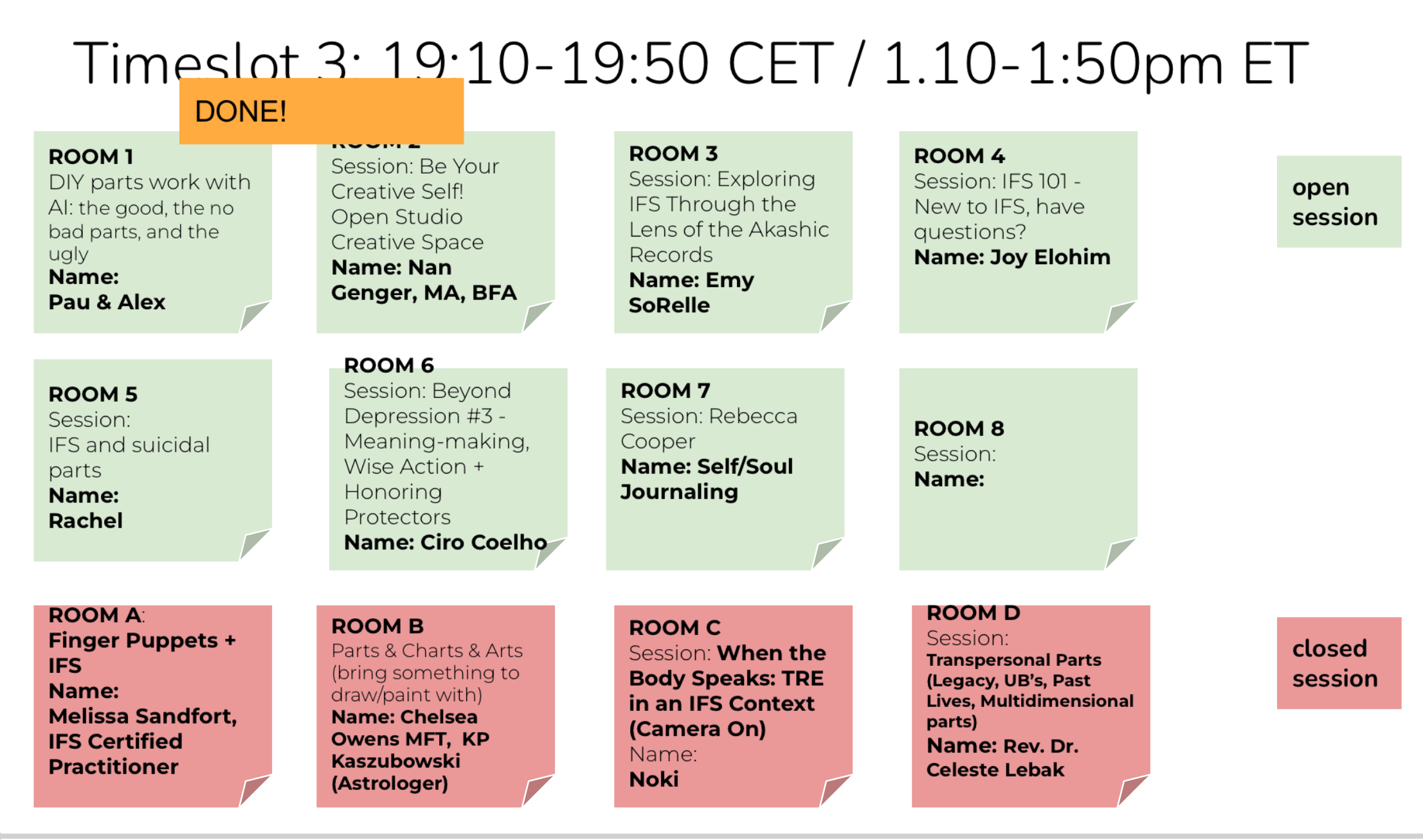
There’s no fixed program when we begin. We all make the program, live at the start of the event, in a part we call the marketplace. Anyone can offer a session: a topic, a question, a practice, a half-baked idea they want to think out loud about. We write them onto a living schedule together, sort out the clashes, and then we go.
If you or your parts like knowing exactly what’s about to happen, this can feel disorienting for the first twenty minutes. That’s normal. Put on your (virtual) seatbelt and maybe even goggles, and trust that it works. Because it does, and it settles fast.
How it works
The one Law
There is exactly one law, and it’s a generous one. We call it the Law of Mobility.
You are free to move. If you’re in a session and your parts light up (where has this been all my life) stay. If they go hmm, this isn’t for me, you are not just allowed but encouraged to leave and go find what is. You don’t have to wait for a polite moment. You don’t owe anyone your staying. Follow your curiosity and aliveness: they are the best navigators in the room.
The one Invitation
Alongside the law, one invitation: bring Self-energy. To your own Parts (in IFS), and to each other.
To yourself: go gently, take breaks, step away from the screen when you need to.
To others: we’re often sitting with strangers, sometimes through a screen, with no idea what kind of day they’re having. A little curiosity and kindness lets the whole thing move with more ease.
That’s the whole ask.
The four Principles
Open Space comes with four principles.
Here’s the secret: they all quietly say the same thing: you can’t do this wrong.
- Whoever comes are the right people. Two people in your session? They’re the ones who were meant to be there. Half the event? Same. No pressure either way.
- Whatever happens is the only thing that could have happened. A session wanders somewhere you didn’t plan, or runs out of time mid-thought. That was the session.
- It starts when it starts. Sometimes a room chit-chats for twenty minutes and then the real thing arrives. Let it.
- It ends when it ends. Some sessions finish early because everything got said. Some don’t want to end at all, and a few have turned into groups that kept meeting afterwards, for moths or years, online and in person. That’s allowed too.
The agreements
A few things we hold firmly, because they keep the space safe enough for real work:
- Confidentiality. What happens here stays here. Share your own experience and what you learned freely; please don’t carry other people’s stories out of the room.
- No recording. By anyone, including AI notetakers (we decline those at the door). The sessions can touch tender places, and that asks for a room that isn’t being captured.
- This is not therapy. It’s a space full of therapeutic content and skilled practitioners, and people do offer real care, but it isn’t a place that can provide therapy to everyone who might need it in the moment. Bring Self-energy to your own parts, and lean on the community gently.
- We are the IFS Collective, not the IFS Institute. The Institute has asked us to be clear about this: we aren’t affiliated with them, and attending doesn’t earn you any educational credits or rights with IFSI. We’d hand them out if we could; we can’t, because we’re not them.
One practical note that follows from safety: you’ll need to sign-in to your Zoom account to join, so we know who’s in the room.
It’s a small hurdle that lets the rest of the space stay open.
How the day flows
- We open together: a short welcome, a moment to land and acknowledge the parts that brought you.
- The marketplace: anyone who wants to offer a session names it, and we build the live schedule together on screen. Sessions shuffle around a bit until we lock it; that’s normal.
- Session blocks: four blocks, each session around forty minutes. Before each block, we quickly run through what’s on offer so you can choose.
- It ends when it ends: we close the formal part, and usually leave the room open a while for whoever wants to linger.
Open vs. closed rooms: most sessions are open: wander in mid-way if you like. A few are marked closed, which means: join in the first few minutes or catch it next time, so the container can hold.
The facilitator will decide which theirs is, and it’s color coded in the living schedule.
A few hand signals
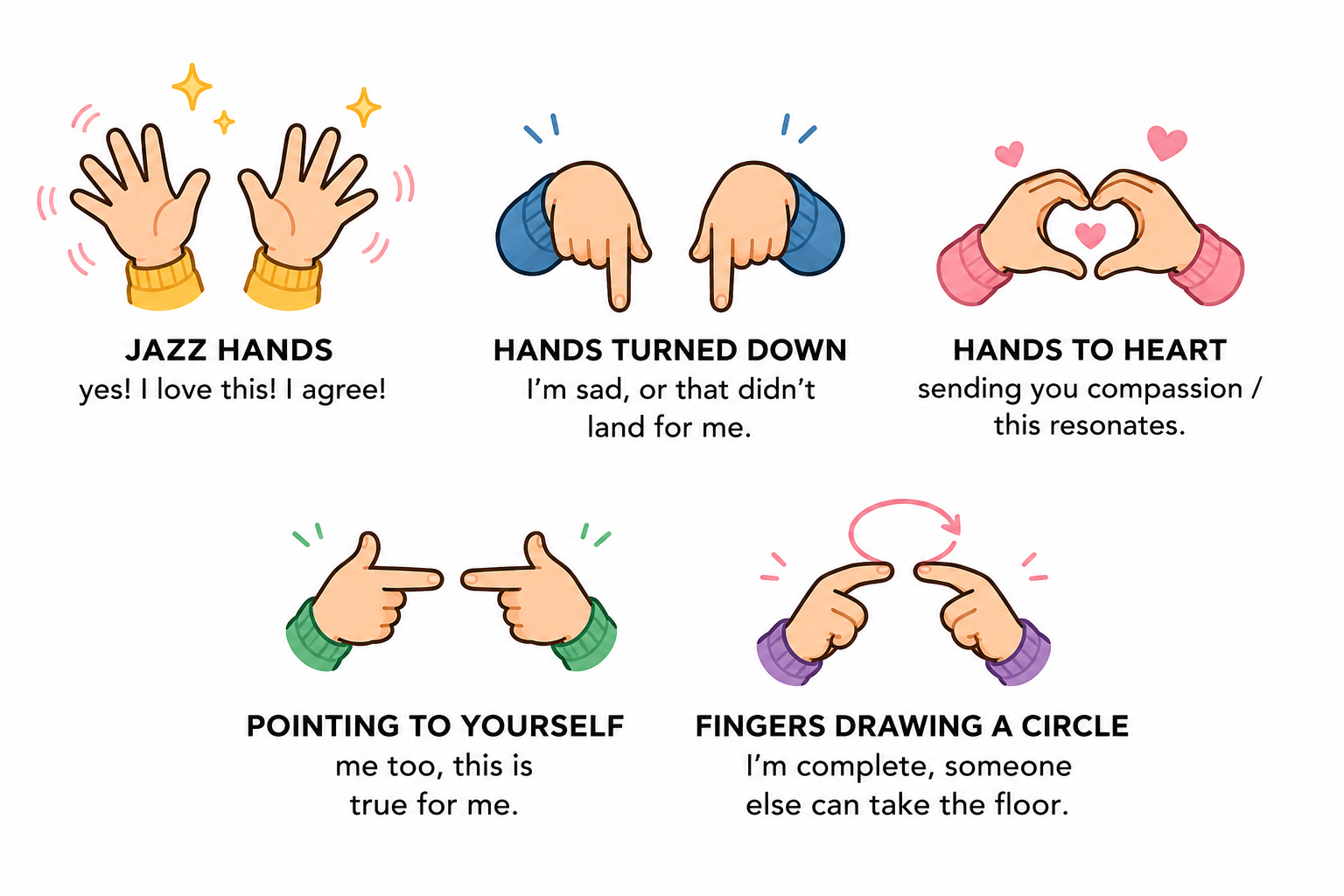
We’re a talkative species, but some things move faster without words. You’ll see us use:
Jazz hands (wiggle both hands): yes! I love this! I agree!\ Hands turned down: I’m sad, or that didn’t land for me.\ Hands to heart: sending you compassion / this resonates.\ Pointing to yourself: me too, this is true for me.\ Fingers drawing a circle: I’m complete, someone else can take the floor.
One last thing: the marketplace isn’t a market
We ask you not to use sessions to sell. Leave your website in the chat, let people find you, absolutely... but keep the sessions themselves a gift to whoever’s in the room. If you do want to share what you offer professionally, there’s a thread in our Telegram group for exactly that, so it has a home without taking over the space.
That’s it.
The rest, we find out together, like kids deciding okay, now we’re playing this.
See you in the room.
AND NOW FOR SOME SHAMELESS COMMERCIALISM
We don’t organize the Unconference to make money, and yet some of our parts like being able to pay bills and eat. We do that by offering IFS therapy and IFS coaching sessions. See here if you’re curious about the difference, and read our posts about our approach. If you feel called, or know someone who wants to dip into this world, feel free to explore booking a session with one of us.